Video Value Series #1: Selling Versus Task Collaboration and Video Value
 Video Value Series #1: Selling Versus Task Collaboration and Video Value by Phil Edholm
This paper is the first in a series of three papers on the value of video in organizations. The three papers are intended to provide a basis for analyzing roles and use cases for video from a value and ROI perspective. This paper focuses on the value of video and the specific interaction situations where video is critical to the success of the outcome.
Many organizations have invested significantly in video conferencing as a technology, often under the belief that it would have significant impacts on the business. While there is no question that video can have an impact, in many cases the way it was installed significantly reduced the value. This paper will address some of the issues that have limited the success of many deployments to date.
In the 1970s, Alphonse Chapanis, one of the pioneers of industrial design, undertook to understand how humans could best interact with machines. In his seminal work, published in the International Journal of Man-Machine Studies in 1974, he documented the results of a significant set of tests. He and his partner, Robert Ochsman developed a test methodology to evaluate different communications modalities. As they did not have machines capable of real thought, they used human subjects. They placed a "sender" of information in one room and a "seeker" of that information in another room. The information that was transmitted was required to complete a task, such as assembling a BBQ grill. They used 10 different communications modalities, ranging from typing, handwriting, voice, and finally opening a curtain so the two participants could see each other. They measured time to completion as the measure of the relative value of each modality. The key finding of this project was that human speech was the key value in completing the task quickly. When voice was added, the time to completion dropped dramatically. Figure 1 shows how the relative values of some of the modalities compared. This study results in an interesting observation; the way humans "do" interactive problem solving is primarily through speech. While a picture can say a thousand words, that is a limit. If I have a picture of four people standing in front of Diamond Head on Waikiki in swimsuits, I can derive certain information. But knowing the name of the third person from the left and the fact they were on a business trip and just out for an afternoon can only be derived through a vocal interaction with someone familiar with the picture. If you think of how you interact, it is with words. Whether this is short, through text messages, or longer with audio speech, task activities involve language.
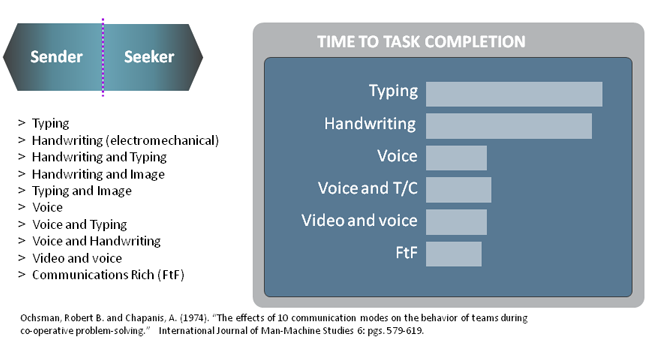
Figure 1 Ochsman/Chapanis Modality Outcomes
A second analysis of the value of different interaction types comes from Antonio Michailidis and Ray Rada “Organizational Roles and Communications Modes in Team Work.” They investigated the preferred communications modalities between a variety of different work types. The conclusions are that certain types of interactions require face to face, while others can be done with lesser modalities. The results of these analysis are shown in Figure 2. They developed a model on the left for comparing modalities based on both Expressiveness and Interactivity, while on the right you can see that FtF was the preferred modality at the Chair to Chair level. As the communicators became more familiar and worked together more often, the modalities moved to being less expressive. This was a result of both familiarity and task focus.
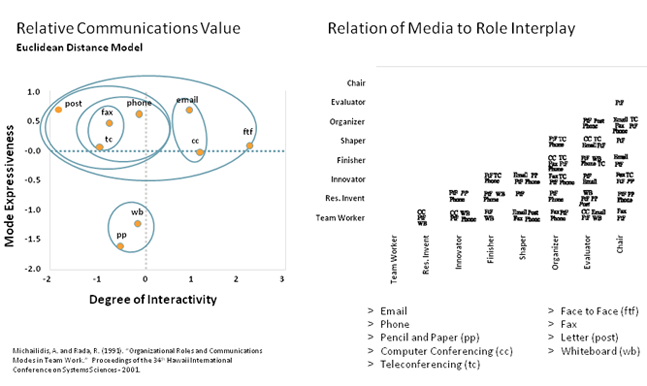
Figure 2 Comparing Modalities Based on Roles
Taking these two studies together, there is a conclusion that a model can be created to view communications modalities against relationship. This model, shown in Figure 3 shows that, as relationships move from having no prior meetings on the left to a familial relationship on the right, the acceptable communications modalities change. The acceptable modalities on the let are face to face and then video, while in the middle, voice, email, or text are all acceptable. Overlayed on this model is a concept that there are three modalities of communications or collaboration; selling collaboration, task collaboration, and grandma mode.
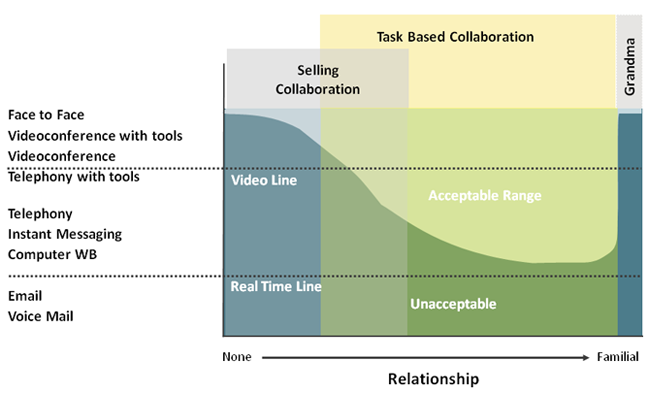
Figure 3 Communications Modalities versus Relationship
-
Selling Collaboration is when there is a requirement for the sender to get visual feedback clues from the receiver to proceed. The term "Selling" is used, as this generally involves selling something. It may be an idea, it be a product or service, or it may be a relationship. Seeing the real-time reaction of the receiver to what has been said is critical. Generally Selling Collaboration events do not have a defined process or outcome as the Task Collaboration events do. Often in Selling Collaboration the goals or motivations for both parties are not aligned. Certain organizational classes spend much if not all of their time in Selling Collaboration. A board of directors for example is always in this mode. Many executives spend almost all their time in this mode as they are dealing with customers or other executives who may not have aligned goals or issues.
-
Task Collaboration is when the focus of the collaboration event is a defined as a specific outcome or process. These events are very similar to the interactions that Chapanis and Ochsman tried to duplicate in their tests. It is two or more participants, who all have a common motivation and desire to get the outcome, and need to interact to make it happen. The point of being task based is that feedback is around the task and if something is not understood, it will be questioned. As can be seen, reflecting both of the cited studies, the acceptable modalities now include a much wider range.
-
Finally, at the far right, when the relationship becomes familial, the value of visual modalities returns, grandma wants to see the grandkids.
As can be seen, there is an overlap of the Selling and Task Collaboration areas. In this area, the collaborators are using different capabilities dependent on the specific outcome and relationship. If the relationship is closer and driving a mutual goal, it will be a Task Based Collaboration, if it is not a mutual goal, often Selling Collaboration will be important.
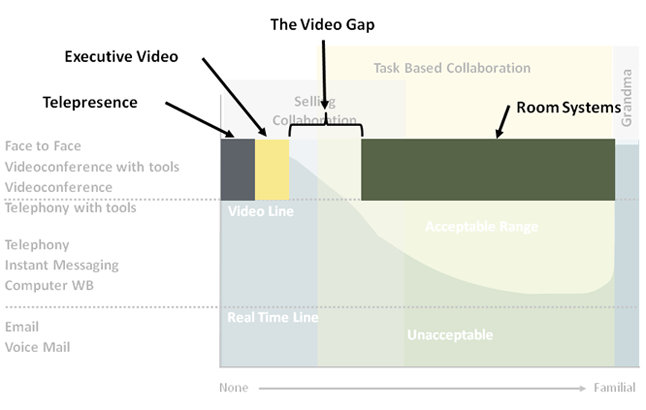
Figure 4 The Video Gap
The result of this chart can now be overlayed with typical video systems as shown in Figure 4. As can be seen, there is clear alignment of both telepresence systems and executive video to the needs of the executive, board member, and high value customer interaction. However, room systems that are distributed out in the general working population often cover interactions that are Task Based. These interactions generally do not need Selling Collaboration for successful completion. The challenge of finding and booking a room, along with the resultant time delays, has led to significant underuse of these rooms. In fact, at a recent conference, one customer said they were removing over 30% of their room systems as they upgraded to HD, Further, some systems had been unused for over 2 years. For the CIO and team considering video, having a clear understanding of the roles and use cases for video prior to investing in a major roll-out is critical. For room systems, monitoring use of initial systems should precede expansion and growth.
However, this chart also shows us the potential gap in today's video solutions; the gap between the relatively expensive executive video system and the room system. This is an area where the mid-manager, who can benefit from video in some of their interactions does not have a viable solution today. For this manager, booking a room system for a one on one meeting with a peer is both difficult and often not possible due to the ad-hoc nature of such interactions. In the next paper in this series, we will discuss the value of "Middle Video" and how it has potentially more value to most organizations than either executive or room video.
References
Ochsman, Robert B. and Chapanis, A. (1974). “The effects of 10 communication modes on the behavior of teams during co-operative problem-solving.” International Journal of Man-Machine Studies 6: pgs. 579-619.
Michailidis, A. and Rada, R. (1991). “Organizational Roles and Communications Modes in Team Work.” Proceedings of the 34th Hawaii International Conference on Systems Sciences - 2001.